
The rapid evolution of Artificial Intelligence (AI) in recent years has transformed nearly every industry — and DevOps is no exception. From automated code reviews to predictive incident management, AI-powered tools are reshaping how software is built, tested, deployed, and maintained.
Will AI replace human DevOps engineers, or will it become their most powerful collaborator?
In 2026, this debate is more relevant than ever. With advancements in generative AI models like OpenAI's GPT systems and developer platforms such as GitHub Copilot, automation has reached unprecedented levels. At the same time, enterprises continue to rely heavily on human expertise to architect, secure, and manage complex systems.
Understanding DevOps in 2026
DevOps in 2026 has evolved far beyond basic CI/CD automation into a comprehensive, intelligent, and cloud-driven operational model. Modern DevOps integrates Continuous Integration and Continuous Deployment (CI/CD), Infrastructure as Code (IaC), cloud-native architectures, and advanced orchestration platforms like Kubernetes to manage scalable containerized applications efficiently. It also emphasizes observability and real-time monitoring, proactive DevSecOps security integration, and Site Reliability Engineering (SRE) principles to ensure high availability, resilience, and performance. Today’s DevOps is not just about faster deployments—it is about building secure, automated, self-healing, and highly reliable digital ecosystems.
The Rise of AI in DevOps
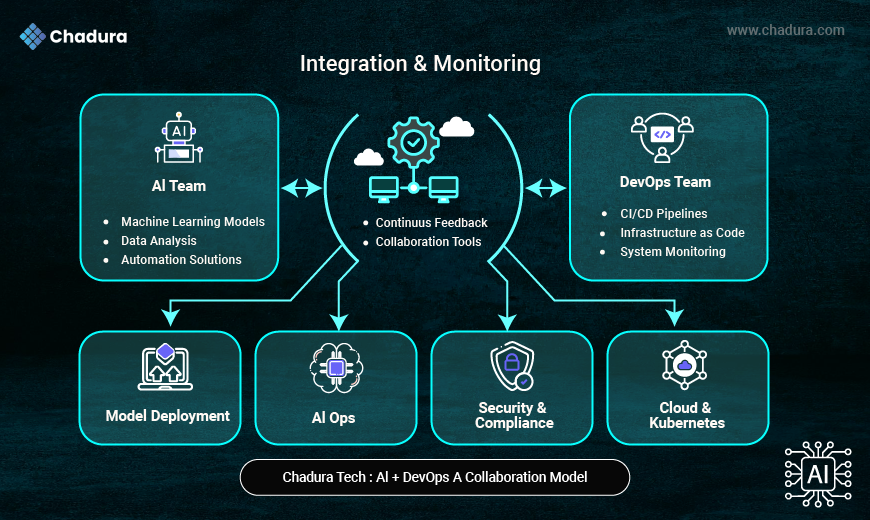
AI is rapidly transforming DevOps by automating monitoring, incident detection, and deployment processes.With AIOps, teams can predict failures, reduce downtime, and optimize cloud performance using intelligent insights.This shift enables DevOps engineers to focus more on innovation and strategy rather than repetitive operational tasks.
AI in DevOps — often referred to as AIOps — focuses on:
- Automated log analysis
- Predictive failure detection
- Intelligent monitoring
- Automated remediation
- Smart scaling decisions
- Code generation and optimization
Cloud providers such as Amazon Web Services, Microsoft (Azure), and Google (Google Cloud) now embed AI-driven services directly into their DevOps ecosystems.
AI tools can now:
- Analyze millions of logs in seconds
- Detect anomalies before outages occur
- Predict deployment risks
- Generate infrastructure templates
- Suggest security patches automatically
But does this mean DevOps engineers are becoming obsolete?
Where AI Excels in DevOps
AI excels in DevOps by processing massive volumes of logs, metrics, and events in real time to detect anomalies and predict failures.
It automates repetitive tasks like scaling, monitoring, and incident response, improving speed, accuracy, and operational efficiency.
1. Speed and Scalability
AI processes data at machine speed. For example:
- Log correlation across distributed systems
- Real-time anomaly detection
- Performance pattern analysis
Traditional monitoring tools would require hours of manual review, whereas AI can deliver insights instantly.
2. Pattern Recognition
AI models trained on historical incident data can:
- Predict outages
- Identify root causes
- Detect subtle performance degradation
Human engineers may miss these patterns due to data volume and fatigue.
3. Automation of Repetitive Tasks
AI can automate:
- CI/CD pipeline creation
- Code linting and optimization
- Infrastructure provisioning templates
- Security vulnerability scanning
This significantly reduces operational overhead.
4. Self-Healing Systems
In Kubernetes environments, AI can:
- Restart failed pods
- Reallocate resources
- Trigger automated rollbacks
Platforms integrated with Kubernetes increasingly leverage intelligent scaling and remediation.
Where Humans Still Lead
Humans still lead in strategic decision-making, architecture design, and complex problem-solving that require business context and critical thinking.
They provide creativity, ethical judgment, and cross-team collaboration—areas where AI cannot replace human insight.
Despite AI’s strengths, human DevOps engineers remain irreplaceable in several key areas.
1. Architectural Decision-Making
Designing a multi-region architecture across Amazon Web Services and Microsoft requires:
- Business understanding
- Cost-benefit analysis
- Security considerations
- Compliance awareness
AI can suggest options — but strategic trade-offs demand human judgment.
2. Creativity and Innovation
AI generates solutions based on training data. Humans:
- Invent new deployment patterns
- Design new reliability models
- Create custom automation frameworks
Innovation still stems from human creativity.
3. Ethical and Security Oversight
AI systems can:
- Introduce biased configurations
- Generate insecure infrastructure code
- Misinterpret context
DevOps engineers must validate, secure, and govern AI-generated outputs.
4. Crisis Management
In real production outages:
- Stakeholder communication
- Decision prioritization
- Cross-team coordination
These are deeply human responsibilities.
AI can provide insights — but humans lead the response.