
Abstract
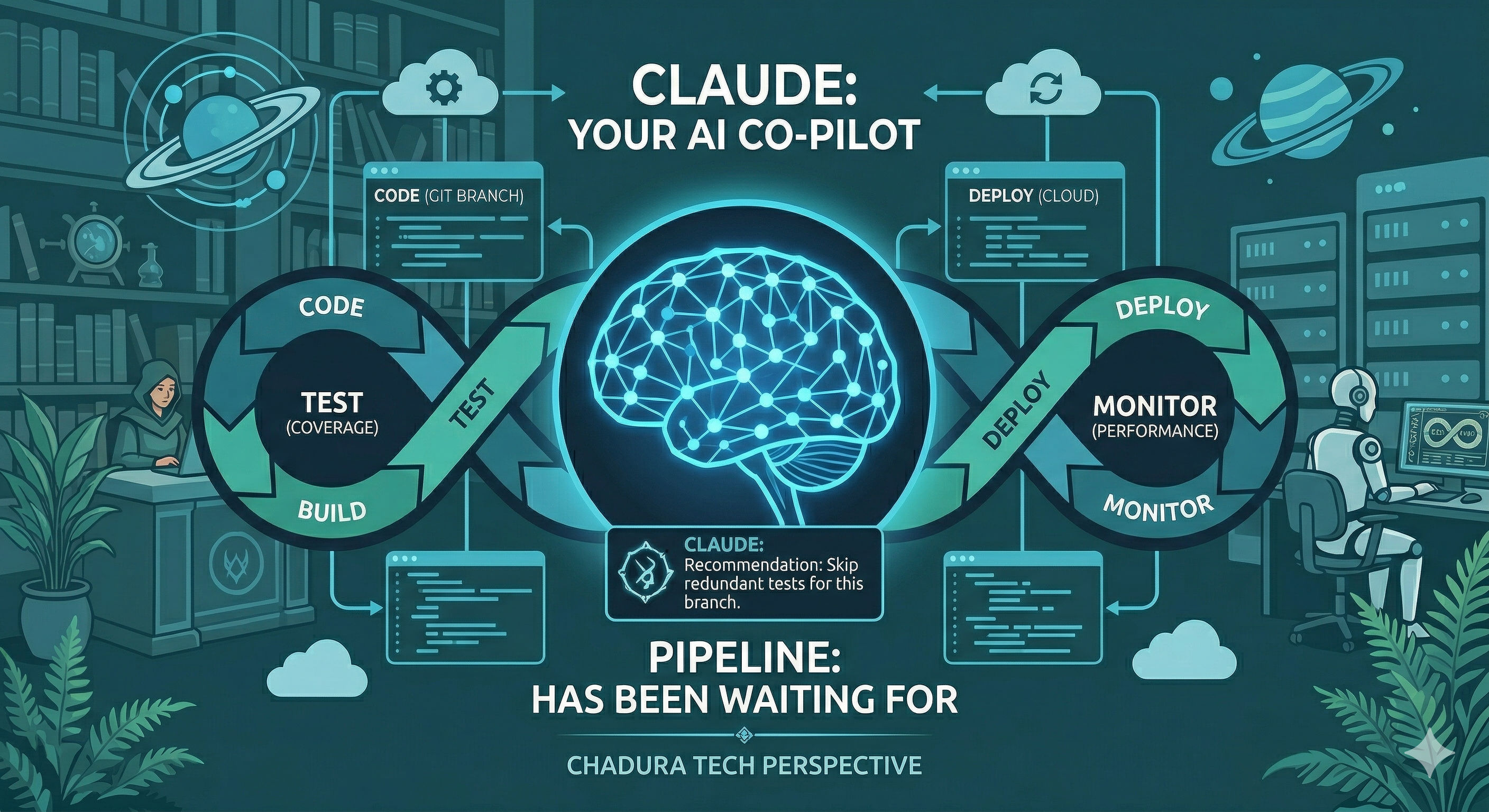
Modern DevOps has evolved from simple automation into a complex, data-driven ecosystem where speed, scalability, and reliability are critical. In this landscape, AI-powered tools like Claude AI are emerging as intelligent co-pilots that enhance how teams design, deploy, and manage software pipelines. This blog explores how Claude AI integrates into DevOps workflows—supporting CI/CD automation, infrastructure as code, and incident response through advanced reasoning and pattern recognition.
From Chadura Tech’s perspective, AI in DevOps is not about replacing engineers but augmenting their capabilities. By reducing human error, accelerating decision-making, and enabling proactive system management, AI-driven DevOps creates more efficient and resilient pipelines. However, the blog also highlights critical limitations, including over-reliance on AI, security concerns, and the need for human validation. Ultimately, it presents a balanced view of how Claude AI acts as a force multiplier in modern DevOps while reinforcing the importance of skilled engineering oversight.
Introduction
DevOps was born out of a simple but radical idea: break the wall between development and operations, ship faster, and fail less. For over a decade, teams have invested in CI/CD pipelines, containerisation, infrastructure as code, and observability platforms to make that vision real.
But there has always been a bottleneck that tooling alone could not fix — the human cognitive load. On-call engineers drowning in alerts. Developers context-switching between feature work and production fires. Platform teams writing the same Terraform modules and Dockerfile templates over and over again.
Enter Claude — Anthropic's AI assistant — now finding a serious home inside DevOps workflows. Not as a chatbot that answers questions, but as an active collaborator that reads logs, writes pipelines, reviews infrastructure, and helps teams move from reactive fire-fighting to proactive engineering.
This blog explores exactly how Claude fits into modern DevOps, where it delivers the most value, and what the teams adopting it are actually experiencing.
1. The DevOps Pain Points Claude Was Built to Solve
Before diving into use cases, it is worth naming the problems that slow DevOps teams down most:
Toil. Repetitive, manual, automatable work that consumes engineering hours without producing lasting value — writing boilerplate configs, updating runbooks, triaging routine alerts.
Context switching : A developer mid-sprint suddenly owns a production incident. An SRE switches from capacity planning to debugging a flaky test suite. The mental cost is enormous.
Knowledge silos : Critical tribal knowledge lives in the heads of a few senior engineers. When they are unavailable, the whole team slows down.
Alert fatigue : Modern observability stacks generate thousands of signals. Teams tune out noise — and sometimes tune out real problems too.
Onboarding friction : A new engineer joining a mature platform may spend weeks just understanding the architecture before contributing meaningfully.
Claude addresses all five — not by replacing the engineers, but by compressing the time each problem takes to resolve.
2. Claude in CI/CD Pipelines: Smarter Automation at Every Stage
Writing and Reviewing Pipeline Configuration
GitHub Actions YAML, GitLab CI, Jenkins pipelines, CircleCI configs — these are notoriously fiddly to write correctly and even harder to review at speed. Claude can draft a full pipeline from a plain-English description, review an existing pipeline for security gaps or inefficiencies, and explain what each stage does in language a junior engineer can understand.
Example: "Write a GitHub Actions workflow that builds a Docker image, runs pytest, pushes to ECR on merge to main, and deploys to ECS Fargate with a rollback on health check failure." Claude produces a working, production-ready YAML in seconds — something that might take a mid-level engineer 30–45 minutes to research and assemble.
Pre-Merge Code Review Assistance
Claude integrates into PR workflows to provide a first-pass review before human reviewers see the code. It checks for security anti-patterns, missing error handling, hard-coded credentials, and deviations from team conventions. It does not replace human review — it elevates it by ensuring human reviewers focus on architecture and logic rather than style and syntax.
Test Generation
One of the most skipped steps in fast-moving DevOps teams is writing meaningful tests. Claude can generate unit tests, integration test scaffolding, and edge case coverage from existing code — reducing the excuse of "we didn't have time."
3. Infrastructure as Code: From Blueprint to Reality
Infrastructure as Code (IaC) is the backbone of modern DevOps, but writing Terraform, Pulumi, Ansible, or CloudFormation correctly requires deep provider knowledge that even experienced engineers look up constantly.
Terraform Modules and Reviews
Claude can write Terraform modules from scratch, review existing configurations for cost inefficiencies (over-provisioned instance sizes, missing lifecycle rules on S3 buckets), security misconfigurations (overly permissive IAM policies, public S3 buckets), and compliance gaps. It can also explain what a complex module does to a team member who did not write it.
Dockerfile Optimisation
Multi-stage builds, layer caching, minimal base images, non-root users — Docker best practices are well documented but inconsistently applied. Claude reviews Dockerfiles and suggests concrete improvements with explanations, turning a 1.2 GB image into a 180 MB one with a clear rationale for each change.
Kubernetes Manifests
YAML indentation errors in a Kubernetes manifest can bring down a deployment. Claude validates manifests, suggests resource requests and limits based on application type, identifies missing liveness and readiness probes, and explains the trade-offs between Deployment, StatefulSet, and DaemonSet for a given workload.
4. Incident Response: From Hours to Minutes
This is where Claude's value in DevOps becomes most visceral. Production incidents are high-stakes, high-stress events where every minute of mean time to resolution (MTTR) has a measurable cost.
Log Analysis at Scale
Pasting a wall of application logs or a stack trace into Claude and asking "what is causing this?" is now a standard workflow on teams that have adopted it. Claude identifies the root cause signal buried in the noise, cross-references it with known error patterns, and suggests the most likely fix — often in under a minute.
Runbook Generation and Execution Guidance
Claude can turn a vague description of a recurring incident into a structured, step-by-step runbook. It can also walk an on-call engineer through an existing runbook in real time, answering clarifying questions and adapting guidance to the specific environment they are working in.
Post-Incident Analysis
Writing a blameless post-mortem is time-consuming and often deprioritised. Claude can draft a structured post-mortem from a timeline of events, a set of Slack messages, or a description of what happened — including a timeline, contributing factors, impact summary, and action items. Teams that use this capability report post-mortems being completed within 24 hours of an incident rather than weeks later.
5. Security and Compliance: Shifting Left with AI
DevSecOps — the practice of embedding security into every stage of the pipeline — is a goal most organisations aspire to and few fully achieve. The gap is usually not intention; it is bandwidth.
Claude helps shift security left in several concrete ways:
- Static code analysis narration: Claude explains what a security scanner flag actually means, why it matters, and how to fix it — in plain language that a developer without a security background can act on.
- IAM policy review: Paste an AWS IAM policy and ask "is this principle of least privilege?" Claude identifies overly broad permissions and rewrites the policy with the minimum required access.
- Secrets detection: Claude can review configuration files, environment variable setups, and deployment scripts for accidentally committed secrets or insecure secret management patterns.
- Compliance mapping: Ask Claude to map your current infrastructure setup against SOC 2, ISO 27001, or CIS benchmarks. It produces a gap analysis that can take a compliance team weeks to generate manually.
6. Documentation: The Work That Always Gets Skipped
Good documentation is the foundation of a sustainable DevOps practice. It is also perpetually deprioritised because it feels like overhead rather than output.
Claude changes this calculus. It can:
- Generate architecture decision records (ADRs) from a description of a technical choice and its alternatives
- Write and maintain runbooks that stay current because updating them with Claude takes minutes
- Produce onboarding guides from a codebase walkthrough
- Create API documentation from code comments and endpoint definitions
- Summarise a week of Slack threads and Jira tickets into a coherent sprint retrospective
Teams that adopt Claude for documentation report a measurable improvement in onboarding time — new engineers reach productivity in days rather than weeks because the knowledge that previously lived in senior engineers' heads is now written down and accessible.
7. Real-World Adoption: What Teams Are Experiencing
Across engineering organisations that have integrated Claude into their DevOps workflows, a consistent pattern emerges:
Time savings are immediate. The first week of adoption typically produces hours of recovered engineering time from pipeline writing, log analysis, and documentation alone.
Junior engineers level up faster. Claude acts as an always-available senior engineer who explains, reviews, and teaches without impatience. Teams report junior-to-mid promotions happening faster when Claude is available as a learning tool.
On-call is less terrifying. Engineers report significantly lower stress during on-call rotations when they have Claude available to help triage incidents. The psychological safety of having a knowledgeable collaborator at 2 AM is not a trivial benefit.
Quality improves without slowing down. The common fear that quality gates will reduce velocity does not materialise. Because Claude handles the mechanical quality checks, human reviewers focus on architectural concerns — and both quality and speed improve.
8. Integrating Claude into Your DevOps Stack
Claude is accessible in several ways that fit naturally into existing DevOps toolchains:
- Claude.ai — Direct conversational interface for ad-hoc queries, log analysis, and document drafting
- Claude API — Embed Claude into internal tools, CI/CD pipelines, Slack bots, and incident management platforms
- Claude Code — A dedicated command-line tool for agentic coding tasks, codebase exploration, and automated engineering workflows
- Claude in GitHub (via API) — Trigger Claude reviews on pull request creation, automate changelog generation, and surface insights in PR comments
The integration path is intentionally lightweight. Most teams start with Claude.ai for individual productivity, migrate high-value workflows to the API, and expand from there.
Conclusion
DevOps has always been about doing more with less — less friction, less toil, less time between idea and production. Claude represents the next meaningful step in that journey.
It does not replace the engineers who design systems, make architectural decisions, and carry operational responsibility. What it does is relentlessly compress the time those engineers spend on mechanical work — writing boilerplate, reading logs, generating documentation, drafting post-mortems — so they can spend more time on the work that actually requires human judgment.
The teams winning with Claude in DevOps are not the ones who handed their pipelines to an AI. They are the ones who treated Claude as a senior collaborator: always available, endlessly patient, and remarkably capable — while keeping humans firmly in the driver's seat.
The question for every DevOps team in 2026 is no longer whether AI belongs in the pipeline. It is how quickly you can make it feel at home there.